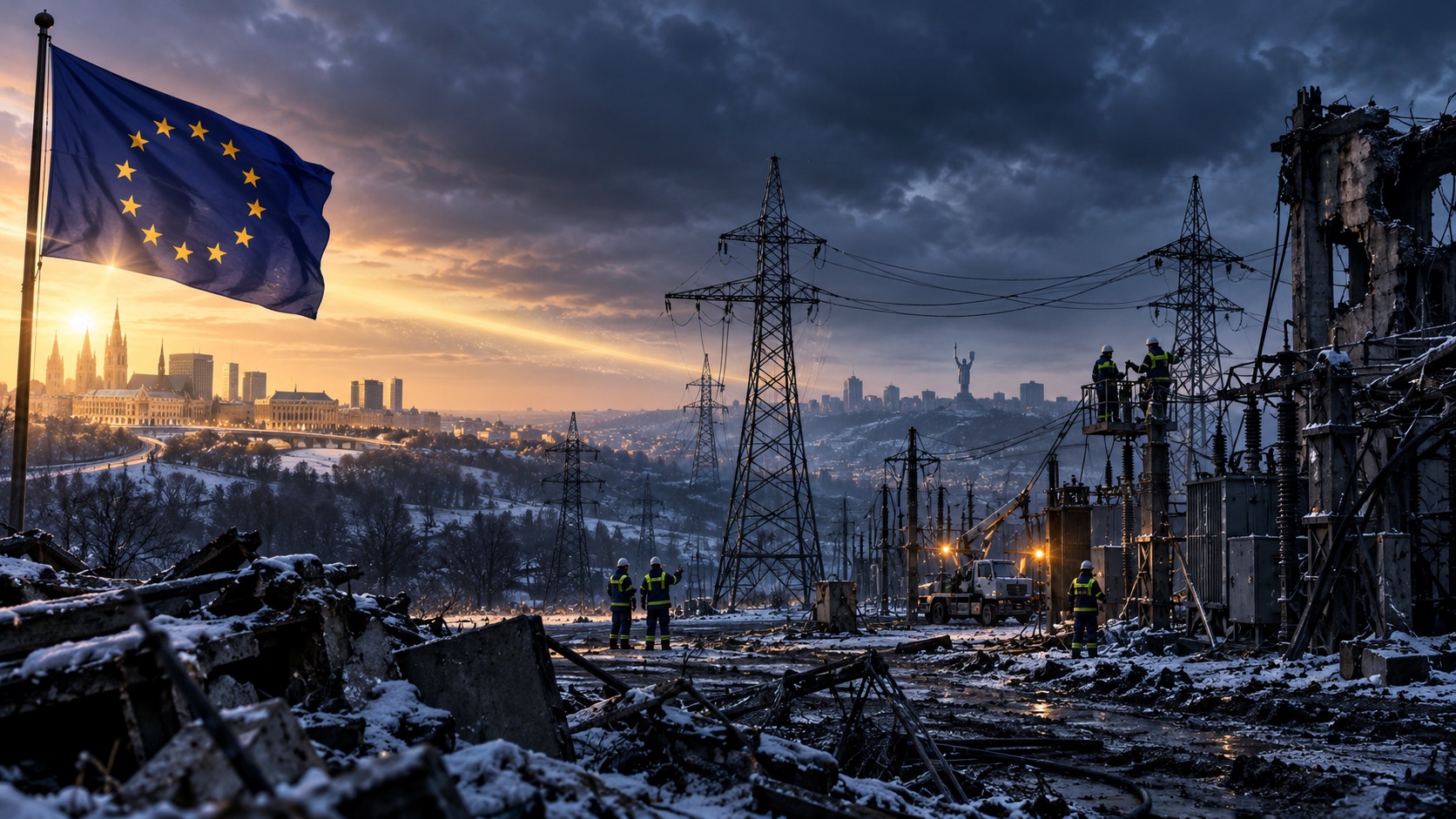
The European Council meets on 16 October with Ukraine's winter electricity system on its agenda. Russian attacks on cities and energy sites have kept the question of repair urgent, according to the Council's June conclusions and Ukraine's president. Brussels can condemn another strike in a sentence; rebuilding a grid takes transformers, crews, protection and money. No new €100 million EU power-grid commitment has been identified at the time of this forecast.
What is known.
The Council's published agenda says leaders will examine the operational needs of Ukraine's critical infrastructure ahead of winter. The June Council conclusions called for intensified help to repair and strengthen Ukraine's energy system and for faster delivery of air-defence equipment. Those statements established a policy direction, but they are not the new, priced aid package defined here.
Ukraine's president said on 12 October that Russian attacks continued after talk of an energy ceasefire. That is the Ukrainian government's account of the attacks; the present forecast does not claim that a specific future strike will happen. The practical test is whether EU institutions commit a separately identifiable amount for the electricity system by the end of October, not whether leaders express solidarity.
What earlier cases show.
EU leaders agreed a €90 billion loan for Ukraine's 2026–27 needs. The Commission also announced a €920 million Winter Energy Plan in February 2026, alongside €100 million for emergency generators and humanitarian aid. Those are substantial precedents, but none can itself satisfy this call: the forecast demands an additional, explicitly electricity-focused commitment announced after publication.
Past winter attacks show why repairing substations and generation capacity can become a race against cold weather. The present episode differs in its precise decision window and in the requirement for a new EU-level price tag rather than an open-ended promise.
Why it is a possibility.
The mechanism is direct. Renewed damage raises the cost and political visibility of winter support; Ukraine requests equipment and protection; the Commission or Council packages additional finance or priced material aid so member governments can point to a concrete response. The summit concentrates that decision pressure into a few days.
The strongest obstacle is institutional rather than rhetorical. EU governments can agree on a statement while leaving a new appropriation, amount or delivery vehicle for later. Existing EU funds could be relabelled as urgent support. The rule therefore excludes old money and unpriced pledges, even if they are useful to Ukraine.
How the 43% was assessed.
Reference point. There is no defensible numerical base rate for EU power-grid packages that meet this exact €100 million, 16–31 October rule. The 43% is an editorial judgment with a rough 30–55% sensitivity band, not a measured frequency or confidence interval. The October Council agenda supplies a near-term opportunity, while June conclusions show established policy intent.
Why it could be higher. A leaders' meeting devoted partly to Ukraine's winter infrastructure and continued reported Russian attacks increase the chance of a newly priced support announcement. A public euro figure would also be politically legible at the summit.
Why it could be lower. The 15-day window is short. The EU may use the existing loan, in-kind supplies or national contributions instead of announcing a new EU-level €100 million earmark. Summit conclusions can stop at general language.
The editorial judgment. The midpoint is below even odds because the defined financial threshold is harder than a call for support. A broader criterion allowing any new energy pledge would deserve higher odds, but would be less useful for scoring.
Limits of the estimate. The decisive uncertainty is what the European Council and Commission announce during and just after the summit. The range is editorial sensitivity, not a statistical interval; official releases alone will settle the rule.
What could prevent it.
Leaders may repeat earlier pledges, rely on the existing €90 billion loan, or announce in-kind help without a qualifying new value. An energy ceasefire or reduced attacks could also alter the urgency.
How it will be assessed.
YES only if a European Commission or Council of the EU public release dated 16–31 October 2026 announces a new EU-level commitment of at least €100 million specifically earmarked for repairing, replacing, protecting or operating Ukraine's electricity generation, transmission or distribution infrastructure. The amount may be a new grant, loan tranche or priced equipment package, but must be additional to commitments publicly announced before 16 October. General political calls, bilateral member-state pledges, the existing €90 billion 2026–27 loan without a new earmark, and unpriced equipment offers do not count. Check the official release record through 31 October; deadline 31 October 2026.
Sources and primary records
Probabilities are provisional editorial estimates, not guarantees. Sources document the present evidence and resolution rule. Read the full disclaimer.
Dated updates.
The first article, forecast rule and original probability above remain unchanged. Each update records a new assessment.
EU summit calls for winter grid support without a new price tag
Originally 43% at publication
European leaders' 15–16 October conclusions say Ukraine urgently needs stronger air defense and a more resilient energy system, including work through the Ukraine Energy Support Fund. They do not announce a new EU-level commitment of €100 million or more earmarked for electricity infrastructure after this forecast was published. The live estimate moves from 43% to 27% because a summit announcement was an important near-term route to YES. The original 43% remains preserved. The call stays open through 31 October; a later, separately priced Commission or Council commitment could still qualify.
How the revised probability was assessed
Reference point. The final summit conclusions support Ukraine's energy system but contain no new priced electricity commitment meeting the frozen threshold. The 27% residual estimate is editorial judgment, not a statistical base rate.
What raises the chance. Leaders explicitly urge urgent energy resilience work, and the Commission or Council may still announce a new separately priced package before 31 October.
What lowers the chance. The summit itself, a natural point for a concrete package, passed with only a general call and reference to existing support channels.
Editorial judgment. Lower the live estimate from 43% to 27% while retaining a real chance of a follow-up announcement.
Uncertainty. The original rule requires an additional EU-level commitment of at least €100 million. The official release record through the full 31 October deadline remains decisive.