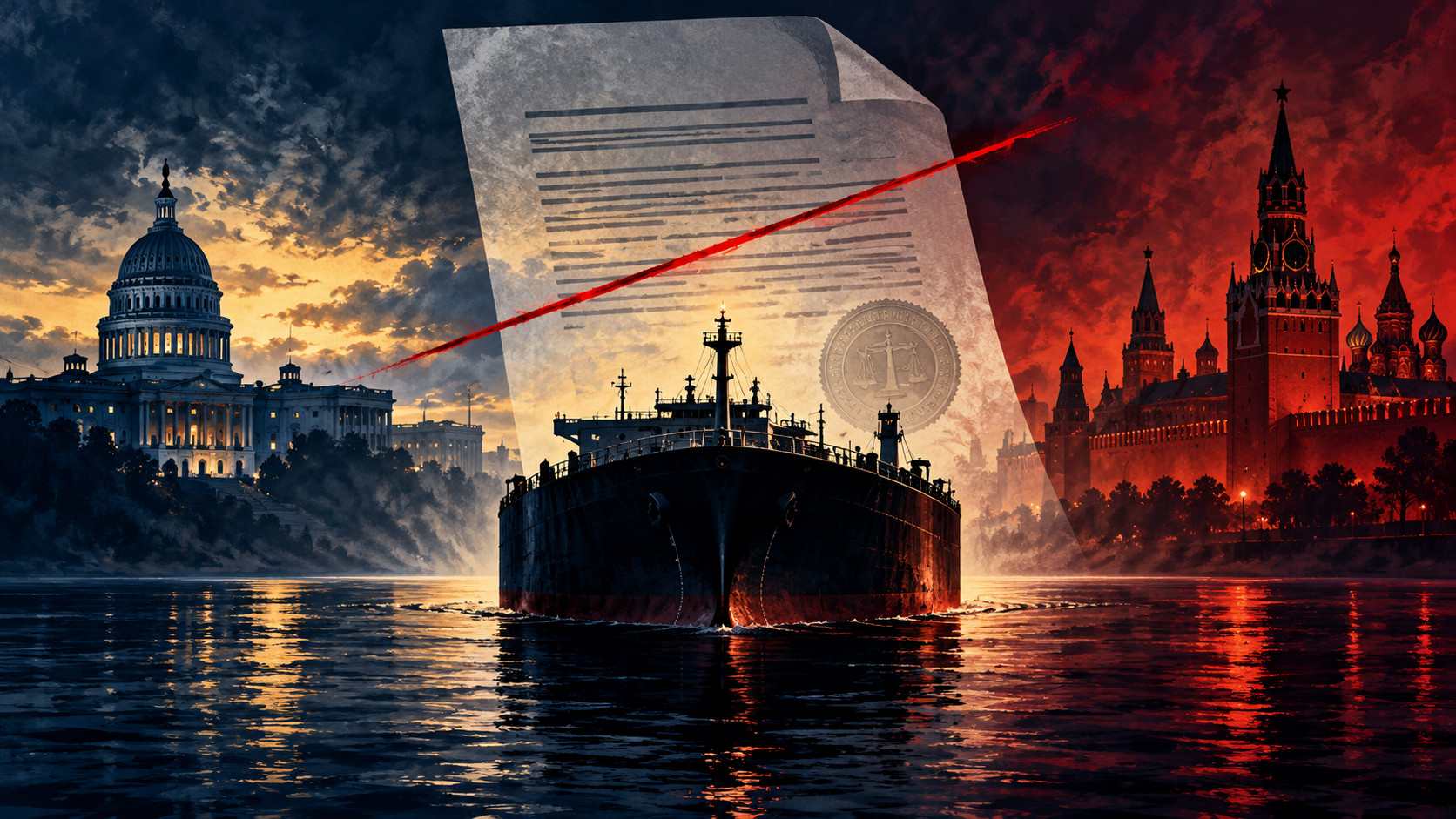
Washington has opened a legal trapdoor in its Russia policy. On 16 October, the White House issued an order implementing the Lindsey O. Graham Sanctioning Russia and Iran Act. The order sets out extremely high potential tariffs and sanctions, then uses section 4 to waive their application. The waiver lasts until the President or Secretary of State decides further action is appropriate. It does not erase older Russia sanctions; the order says those remain untouched. The sharp question now is whether the administration retreats from any Russia-related part of this new waiver before December. No such reversal is established at publication.
What is known.
The order's section 2 lists a potential 500% duty on Russian goods and 100% duties involving large importers of Russian energy or facilitators of Russian oil sanctions evasion. Section 4 then waives those duties and several Graham Act sanctions provisions. That combination gives Washington a formidable threat while postponing its immediate economic bite. This forecast is about the fate of that specific waiver, not the entire US sanctions system.
The same week's European Council conclusions urged more pressure on Russia, including curbing its energy revenues and shadow fleet, and regretted the United States' temporary lift of Russian diesel sanctions. A bipartisan group of US senators had also urged the President to rescind a separate Russian diesel deal. These are signals of political pressure, but neither constitutes a legal reversal of the 16 October Graham Act waiver.
What earlier cases show.
The Graham Act was signed in September, according to the White House order, and contains a national-interest waiver route. Congress can write powerful mandatory penalties while the executive retains a valve for geopolitical and economic conditions. The order demonstrates that tension unusually starkly because it imposes and waives in the same document.
Russia's war in Ukraine and the energy shock around Gulf shipping make the sanctions calculus unusually combustible. Higher duties could squeeze Russian revenue, but could also raise costs for trade partners or interfere with oil supply. This is why a political demand for maximum pressure does not automatically become an enforceable tariff.
Why it is a possibility.
A partial reversal could follow a new Russian attack, congressional pressure, or a decision that the threat of duties has not changed Moscow's behavior. The administration has built a ready-made mechanism: it can leave some waivers intact and withdraw a targeted Russia-related part. An official executive or departmental decision would make that choice public and scoreable.
The strongest countercase is equally concrete. The President chose an open-ended waiver yesterday, and the order explicitly reserves a later decision rather than setting a near-term expiry. The administration may judge that a sudden fuel-price or diplomatic cost outweighs the leverage gained from activation. It could also sanction new entities under older authorities while the Graham waiver stays in place; that would be a policy change, but not this forecast's event.
How the 36% was assessed.
Reference point. There is no reliable historical frequency for reversing a specific one-day-old Graham Act waiver. The 36% estimate is an editorial judgment with a broad 20–50% sensitivity band, not a measured base rate.
Why it could be higher. The order explicitly provides for future action; bipartisan US pressure and the European Council's criticism make the waiver politically contested.
Why it could be lower. The administration deliberately granted a broad waiver and faces energy-market and diplomatic costs from an abrupt reversal. The window is only six weeks.
The editorial judgment. A targeted partial rollback is plausible but less likely than continuation through November. The call requires a precise official legal action, not rhetoric.
Limits of the estimate. The main uncertainty is the administration's response to the war and energy markets. The original 36% will remain frozen even if later reporting changes the live estimate.
What could prevent it.
The administration may maintain every Graham Act waiver through November to avoid disrupting fuel markets and diplomacy. Older Russia sanctions could be strengthened without changing the new waiver and would not qualify.
How it will be assessed.
YES only if a public White House executive order or official US State or Treasury Department determination dated 17 October through 30 November 2026 expressly revokes, narrows, or ends at least one Russia-related waiver granted in section 4 of the White House's 16 October 2026 Graham Act order, thereby making a previously waived Graham Act duty, sanction, or restriction applicable to Russian persons, Russian goods, or a Russia-related oil or gas importer or facilitator. A new sanction under an older legal authority, a threat, a congressional proposal, a routine designation under an unaffected program, or action only against Iran does not count. Use the White House, State, or Treasury publication as the deciding record; deadline 23:59 UTC on 30 November 2026.
Sources and primary records
Probabilities are provisional editorial estimates, not guarantees. Sources document the present evidence and resolution rule. Read the full disclaimer.