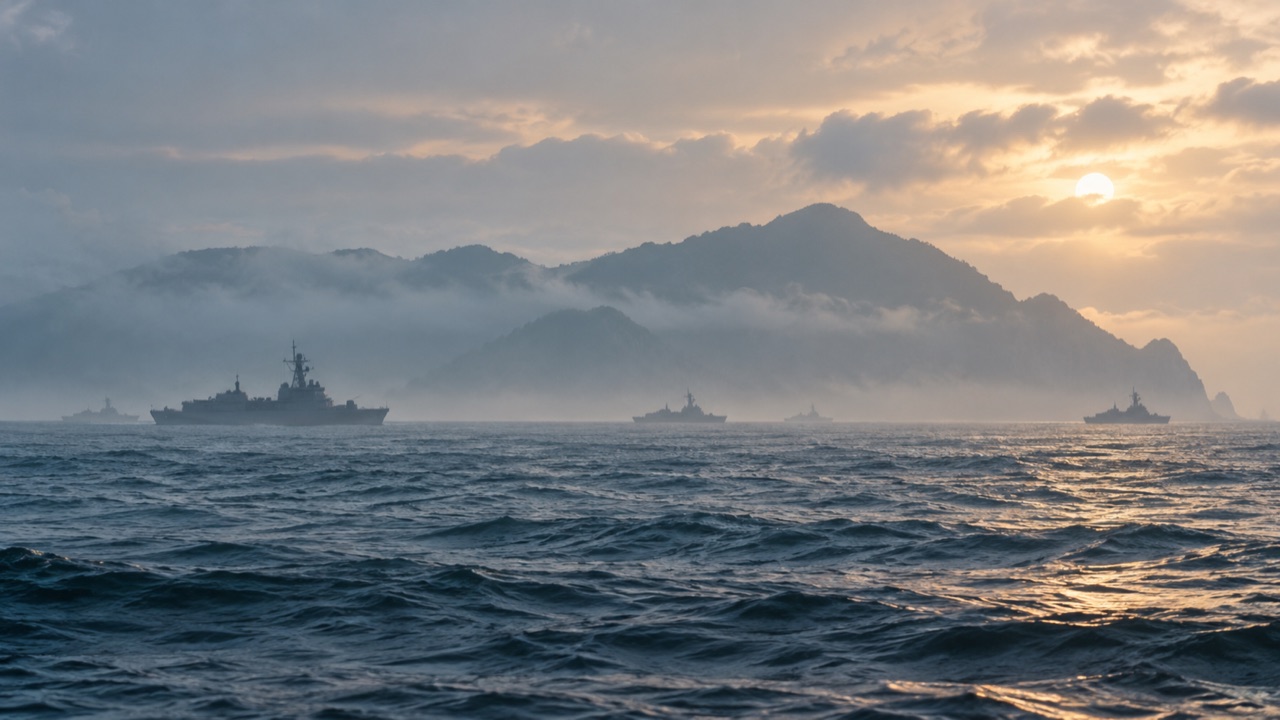
Chinese forces have conducted live-fire exercises in the Taiwan Strait, but there is no verified qualifying strike on Taiwan's main island. The forecast concerns a direct kinetic attack or hostile landing by the end of 2027, a far more serious step than the military activity reported so far.
What is known.
Taiwan's foreign ministry said China announced live-fire exercises for 23 and 24 July 2026 in the western Taiwan Strait. The ministry called the drills destabilizing; the announcement described exercises in a restricted zone, not an attack on the main island.
The US Defense Department's 2025 report sets out possible Chinese military options including a joint firepower strike campaign, blockade and amphibious operations. A military assessment of options and capability does not establish that Beijing has ordered any of them.
The resolution rule deliberately excludes aircraft entering an air-defense identification zone, drills, cyber operations, strikes that land only at sea and incidents limited to offshore islands. A qualifying hit or hostile landing must be confirmed by Taiwan's government and corroborated by another government or the United Nations.
What earlier cases show.
The Defense Department report describes large Chinese exercises around Taiwan in 2024, including simulated blockade operations. Taiwan also reported live-fire exercises in July 2026. Neither is a precedent for a confirmed strike on the main island; both show how coercive signaling can remain below the forecast's threshold.
There is no useful recent frequency of comparable cross-strait attacks from which to calculate a short-term base rate. Analogies to other conflicts miss differences in geography, military capabilities, domestic politics and the likely international response.
Why it is a possibility.
Repeated exercises and the development of military options leave a nonzero chance that a crisis, miscalculation or deliberate escalation could cross the line from coercion to kinetic force. A short strike is operationally different from a full invasion, but both are included only if the published rule is met.
Deterrence and the expected costs weigh heavily the other way. A main-island attack could trigger a broad war, severe economic disruption and diplomatic isolation. The existence of a strike plan is not evidence of a decision to use it.
How the 10% was assessed.
Reference point. The reference point is the absence of a qualifying main-island strike despite repeated exercises and coercive activity, alongside the military options described in the 2025 US Defense Department report. That history supports a low probability but supplies no defensible numerical base rate.
Why it could be higher. Military capability, frequent exercises and the possibility of a crisis or miscalculation mean the risk cannot be treated as zero over the period to 31 December 2027.
Why it could be lower. A direct strike is a much higher threshold than patrols, warnings or a blockade rehearsal. The likely military, economic and diplomatic costs could deter Beijing, and the corroboration rule makes an ambiguous incident insufficient.
The editorial judgment. The editorial judgment range for this tightly defined event was roughly 5–15%, with the unchanged published point estimate at 10%. That places a main-island strike well below a one-in-two outcome while acknowledging a consequential tail risk.
Limits of the estimate. This is not a government intelligence estimate or a calibrated conflict model. The range expresses judgment, not a statistical confidence interval. A new crisis could justify a new dated forecast; the original 10% and its rule remain fixed.
Analysis expanded on 11 Oct 2026. The original published probability and decision rule are unchanged.
What could prevent it.
A main-island strike would carry enormous military, economic, and diplomatic costs; current activity is not evidence that such an operation has begun.
How it will be assessed.
Resolves YES only if an intentional People's Liberation Army kinetic weapon strikes Taiwan's main island, or PLA personnel land on the main island in a hostile operation, by 23:59 UTC on 31 December 2027. The event must be confirmed by Taiwan's Ministry of National Defense or Presidential Office and corroborated by another government or UN statement. Drills, ADIZ crossings, cyber operations alone, accidents, impacts only at sea, and attacks limited to offshore islands do not count.
Sources and primary records
Probabilities are provisional editorial estimates, not guarantees. Sources document the present evidence and resolution rule. Read the full disclaimer.