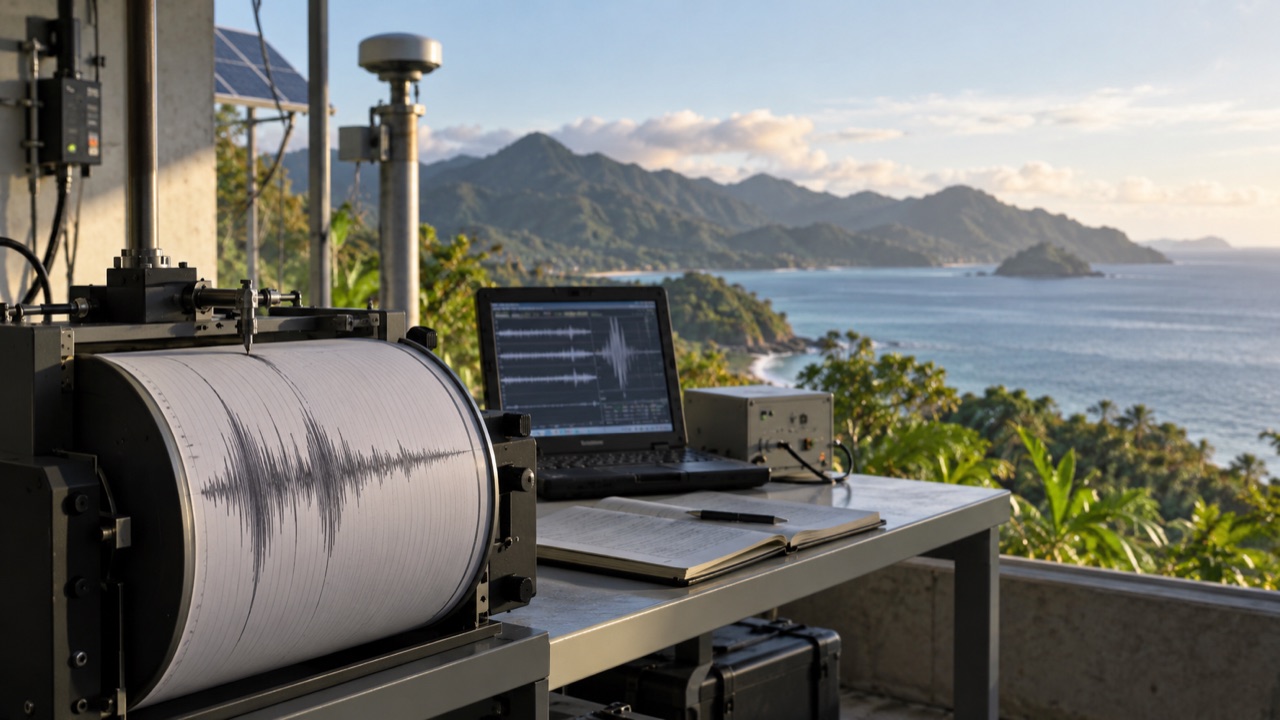
A magnitude 7.7 earthquake struck near Pitaloza Arriba, Panama, on 9 October. Another tremor of magnitude 6 or greater in the surrounding area by 9 November is possible, but no such post-publication event is asserted here.
What is known.
The US Geological Survey lists the mainshock at 17:56 UTC on 9 October, about 12 km west-southwest of Pitaloza Arriba. Its catalogue also records a magnitude 5.8 earthquake near El Cacao roughly 42 minutes later. These reviewed magnitudes establish significant early activity without meeting this forecast's later time window.
The USGS explains that aftershocks usually become less frequent with time, although a larger aftershock can temporarily raise activity again. Its operational forecasts, when issued, use both earlier sequences and the actual sequence as it develops.
This article does not use an official event-specific USGS probability: the mainshock page did not display an operational aftershock forecast when reviewed. The public USGS catalogue will settle whether a magnitude 6.0 or stronger event occurs within 250 km after publication and by 9 November.
What earlier cases show.
Large earthquakes can generate long sequences of smaller events. The magnitude 5.8 tremor soon after this mainshock is evidence of an active local sequence, but its occurrence before publication does not count as a hit.
Aftershock rates vary with the fault system and the sequence's early behavior. Forecasts made for earthquakes elsewhere are useful illustrations of the method, not transferable probabilities for Panama.
Why it is a possibility.
The size of the mainshock and an early event close to magnitude 6 leave a credible path to another strong rupture as stresses adjust. A month-long window captures the period when aftershocks are generally most frequent.
A rapid decline in activity or a sequence concentrated below magnitude 6 would defeat the forecast. Revisions to locations or magnitudes could also affect whether an event meets the exact 250 km and 6.0 thresholds.
How the 38% was assessed.
Reference point. The USGS-confirmed magnitude 7.7 mainshock and nearby magnitude 5.8 event are the local evidence. USGS guidance says aftershock likelihood depends on mainshock size and evolving sequence behavior, but no event-specific USGS percentage was available for this exact test.
Why it could be higher. A very large mainshock and an early magnitude 5.8 tremor keep a magnitude 6 event within a plausible range. The window extends for roughly a month after publication.
Why it could be lower. Aftershock frequency usually decays, many sequences never produce a later event above the chosen threshold, and the 250 km boundary excludes more distant earthquakes.
The editorial judgment. A broad 20–50% editorial range was used for the defined post-publication event, with the unchanged published point estimate at 38%. The estimate lies above a remote-risk judgment because of the mainshock size and observed early activity, while still treating no qualifying event as more likely.
Limits of the estimate. This is not a USGS forecast, and the range is not a statistical confidence interval. A fitted local aftershock model could produce a different number. The original 38% will remain visible even as the catalogue and new evidence evolve.
Analysis expanded on 11 Oct 2026. The original published probability and decision rule are unchanged.
What could prevent it.
Most aftershocks may remain below magnitude 6, and the sequence can decay rapidly without another large recorded tremor.
How it will be assessed.
Resolves YES if the US Geological Survey earthquake catalogue records an earthquake of magnitude 6.0 or greater, with origin time after publication and no later than 23:59 UTC on 9 November 2026, within 250 km of the 9 October 2026 Panama magnitude 7.7 epicentre. The USGS final reviewed magnitude and coordinates control; the mainshock and any event before publication do not count.
Sources and primary records
Probabilities are provisional editorial estimates, not guarantees. Sources document the present evidence and resolution rule. Read the full disclaimer.