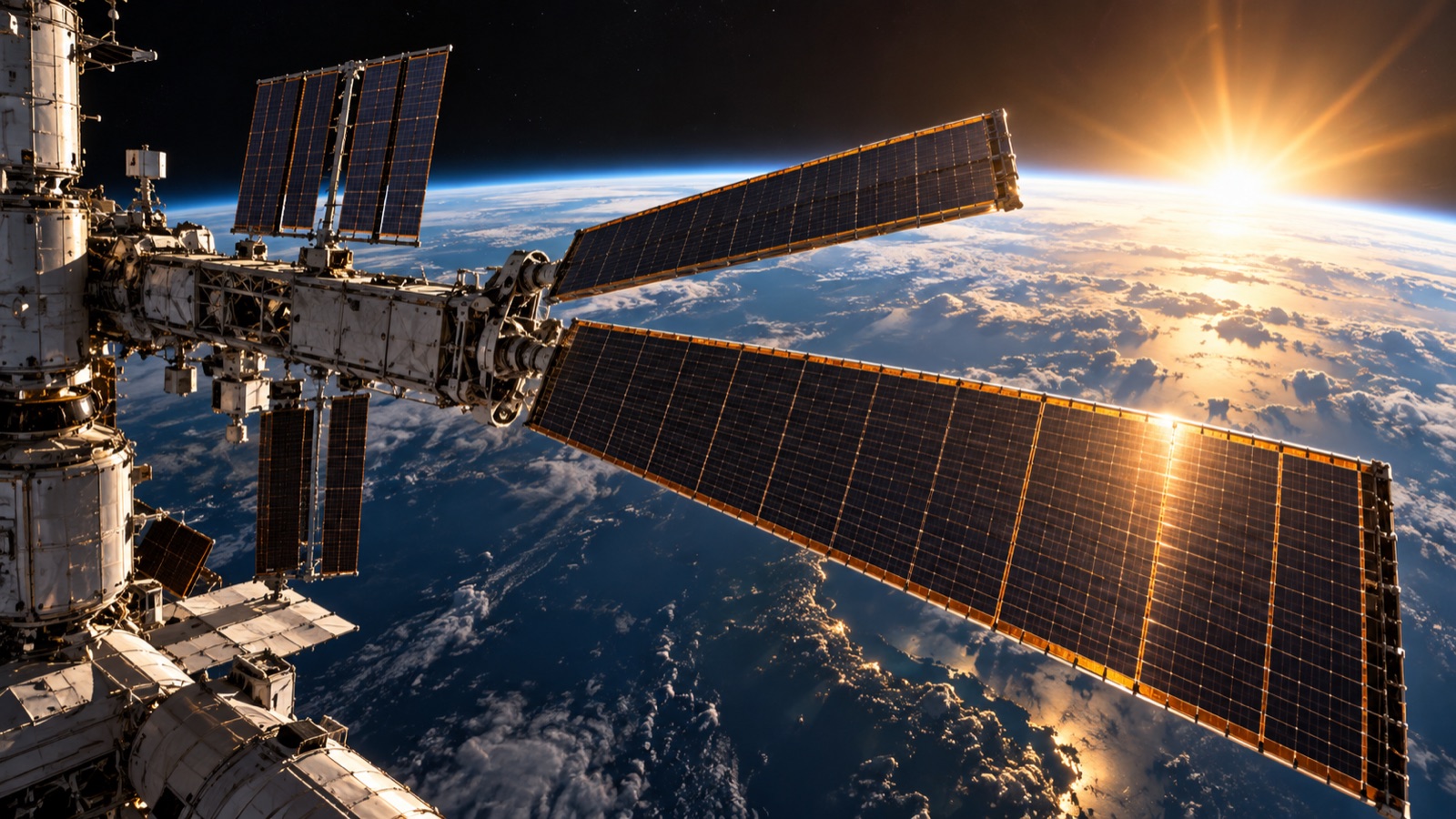
NASA is preparing to finish a power upgrade on the International Space Station that began years ago. Two final roll-out solar arrays reached orbit on a cargo mission, and the agency has scheduled spacewalks for 29 October and 5 November. The forecast is that the eighth array will be installed and deployed by the end of November.
What is known.
NASA says the final pair of arrays can lift available station power by up to 30%, from about 160 to 215 kilowatts when the full set is operating. That power supports research and routine operations, including the station’s eventual safe deorbit.
Delivery is not completion. The second planned spacewalk must install and deploy the eighth array on the 3B channel. A schedule announcement does not score the call; a NASA mission update confirming the work does.
What earlier cases show.
The planned fifth-November spacewalk would be US spacewalk 101, according to NASA’s advisory. The final two arrays follow earlier installation steps in the same augmentation programme. The history shows an established procedure, while station maintenance remains vulnerable to delays.
Why it is a possibility.
The hardware has launched and NASA has publicly assigned two installation dates, leaving weeks of margin before the forecast deadline. That supports a high probability.
Spacewalks can move for suits, crew health, robotic systems, weather effects on supporting operations or station priorities. The seventh wing could be finished while the eighth waits, which would be a NO under this rule.
How the 82% was assessed.
Reference point. The scheduled dates and delivered hardware anchor the estimate; no calibrated historical rate of comparable ISS installation success was computed.
Why it could be higher. NASA has identified the crew, target channels and two near-term spacewalks, with nearly four weeks of slack after the final planned date.
Why it could be lower. A complex EVA can be postponed or only partly complete even after hardware arrives.
The editorial judgment. The editorial point estimate is 82%, with a rough sensitivity range of 65% to 92% to reflect operational risk.
Limits of the estimate. The date range is editorial, not statistical. NASA’s confirmation of deployed hardware on the 3B channel is required.
What could prevent it.
A spacewalk can be deferred by suit, crew, robotic or station-system problems. Delivery to orbit and a scheduled spacewalk do not prove that the final array was deployed.
How it will be assessed.
Count YES only if NASA's official space-station blog, mission update or spacewalk report confirms that the eighth and final ISS Roll-Out Solar Array was installed and deployed on the station's 3B power channel by 23:59 UTC on 30 November 2026. Launch, docking, unpacking, a partial installation, or installation of the seventh array alone do not qualify.
Sources and primary records
Probabilities are provisional editorial estimates, not guarantees. Sources document the present evidence and resolution rule. Read the full disclaimer.