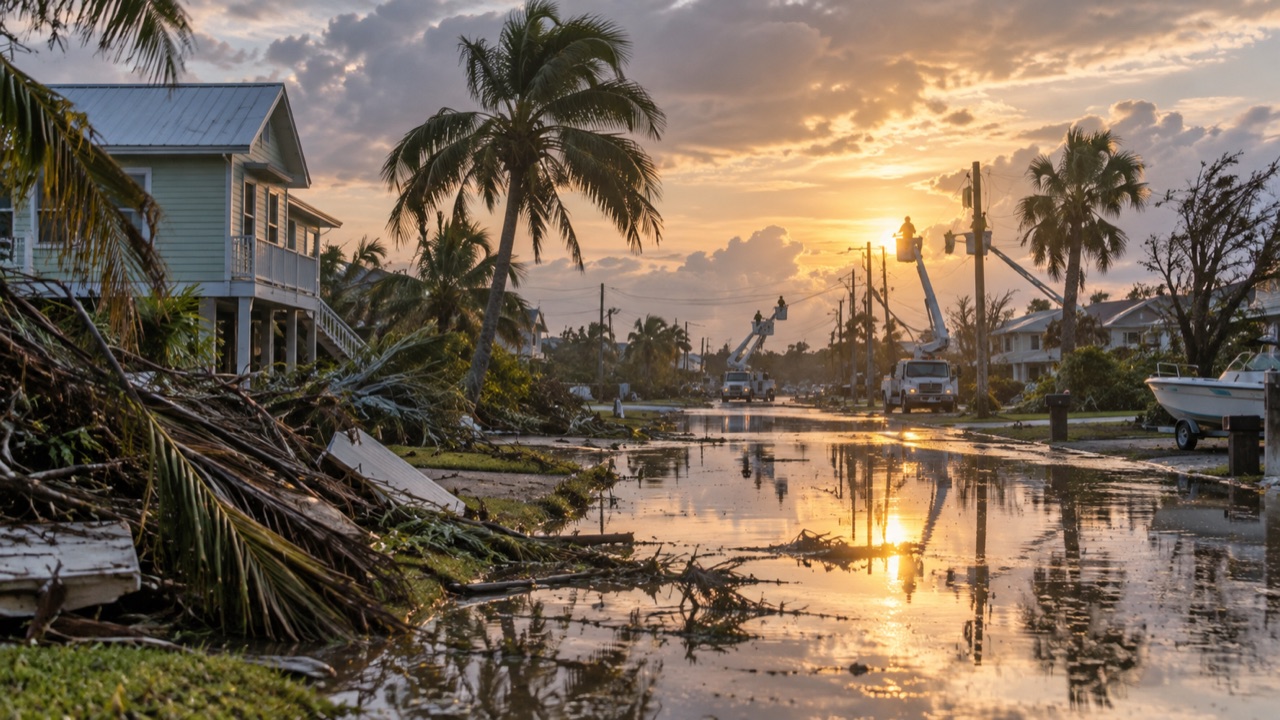
Hurricane Isaias struck Florida's Panhandle on 9 October. The federal government may follow its emergency response with a major disaster declaration, but that requires a separate request and decision.
What is known.
The National Hurricane Center reported landfall near Destin at about 8:30 p.m. local time, with sustained winds near 105 mph. It also reported a Panama City Beach water-level reading 5.6 feet above mean higher high water, an approximation of local inundation. These are storm observations, not a completed statewide damage assessment.
A major disaster declaration begins with a request from Florida's governor and is decided by the president after federal review. FEMA guidance asks for evidence of damage and why state and local resources are insufficient. The extent of losses and the state's request were still uncertain when this forecast was published.
The published rule is narrower than federal help in general: FEMA's public record must show a major disaster declaration for Florida that explicitly names Isaias or its direct effects by 15 November. An emergency declaration on its own would not count.
What earlier cases show.
FEMA recorded major disaster declarations for Florida after Hurricanes Idalia in 2023 and Helene and Milton in 2024. Those examples show that major declarations can follow damaging Florida hurricanes quickly, but they are selected precedents rather than a denominator of all landfalling storms.
Declarations depend on documented impacts, the governor's request and the federal decision. Wind speed at landfall alone does not establish that the legal and administrative threshold will be met.
Why it is a possibility.
Hurricane-force winds, coastal inundation and inland flooding create a credible path to losses beyond local resources. If assessments substantiate widespread damage, a major declaration would provide recovery assistance beyond the immediate emergency response.
The main uncertainty is administrative as well as meteorological. Damage may be concentrated, the state may seek a narrower response, or the formal decision may arrive after the forecast's deadline.
How the 79% was assessed.
Reference point. The NHC landfall observations indicate a damaging storm, and FEMA's records show several Florida hurricane major declarations in recent years. Those examples support a high prior expectation but are not a calculated base rate for this specific storm.
Why it could be higher. The reported 105 mph winds, coastal water level and flood threat make substantial damage and a governor's request plausible. The 15 November deadline allows several weeks for assessment and a decision.
Why it could be lower. The full damage picture was not yet available. FEMA's process requires a request and presidential approval; an emergency-only declaration, a narrower impact or a late decision would miss this rule.
The editorial judgment. The editorial range for a qualifying declaration by the deadline was 65–90%, with the unchanged published estimate at 79%. The strong physical hazard pushes the estimate high; the unmeasured losses and two-step declaration process keep it below near-certainty.
Limits of the estimate. The range is a judgment band, not a confidence interval or FEMA forecast. A systematic comparison of similar storms was not available at publication. Later damage assessments may justify a new forecast but cannot alter the original 79% record.
Analysis expanded on 11 Oct 2026. The original published probability and decision rule are unchanged.
What could prevent it.
Damage assessments could stay below the threshold for a major disaster declaration, or federal aid could be delivered under an emergency declaration without a later major declaration.
How it will be assessed.
Resolves YES if FEMA's public disaster declarations record shows a major disaster declaration, rather than only an emergency declaration, for the State of Florida that explicitly names Hurricane Isaias or its direct effects and is issued by 23:59 UTC on 15 November 2026.
Sources and primary records
Probabilities are provisional editorial estimates, not guarantees. Sources document the present evidence and resolution rule. Read the full disclaimer.